
The second quarter started with investors feeling uncomfortable, as the war in Iran, rising oil prices, a potential for Fed tightening, and growing private credit issues weighed on sentiment. As spring rolled into summer, numerous cease fires and near peace deals with Iran has had a somewhat calming effect. Against that backdrop, markets globally climbed a wall of worry.
In equity markets, the rally in US stocks was interesting. Small cap stocks led the way, with the S&P 500 lagging the Russell 2000. Mid-sized US stocks also participated quite well, essentially in step with the S&P 500. This sounds like a broad rally, and it generally was, but within large cap stocks the equal weight S&P 500 underperformed the S&P 500 by over 4%.

Foreign markets were generally strong as well, but developed markets lagged the US. Emerging markets were better, with the MSCI index rising nearly 25%. Not all emerging market benchmarks were that strong. MSCI considers South Korea an emerging market, while other providers do not. This had measurable impact because South Korean stocks were up over 85%. Without South Korea, other emerging markets were collectively more or less in line with developed market stocks.
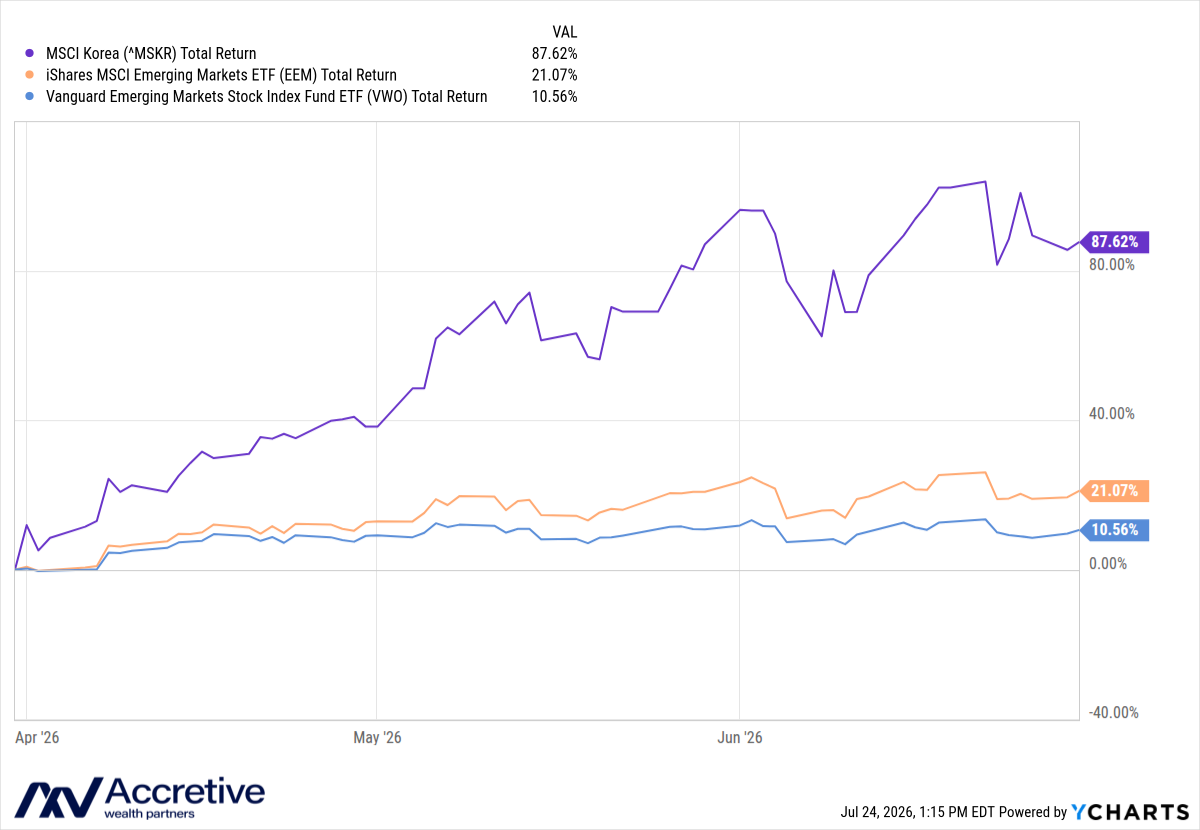
The vagaries of index construction, inclusion or exclusion, and bottom-line impact was also felt even within the US. Take the Russell indices and Nasdaq 100 as an example.
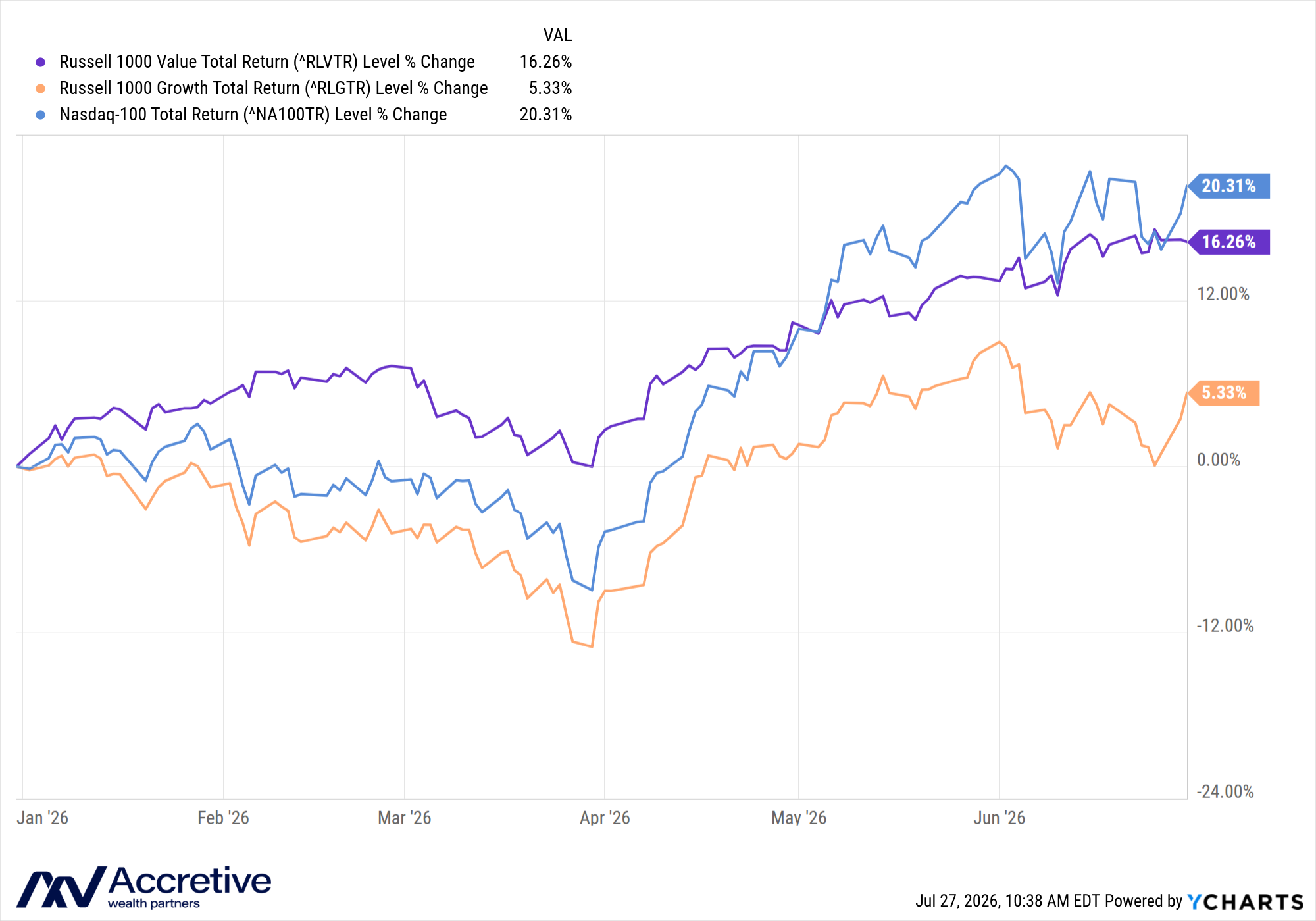
It seems odd in a market led by the AI capex trade that the Russell 1000 Growth would lag both the Russell 1000 Value and the Nasdaq 100 indices by 10 and 15%, respectively. The reason lies in classification going into the year. Going into the year, most MAG-7 stocks were considered growth stocks and memory companies considered value stocks, while the Nasdaq 100 has no such distinction, it is only stocks that trade on the Nasdaq. Every year, Russell reconstitutes the value and growth indices in June. This June’s reconstitution finds the growth index heavy on semiconductors and memory and a good portion of MAG-7 back in the value category. A comparison of the holdings and weights of an ETF that tracks the Russell 1000 Growth Index at the end of May and today in July is revealing.
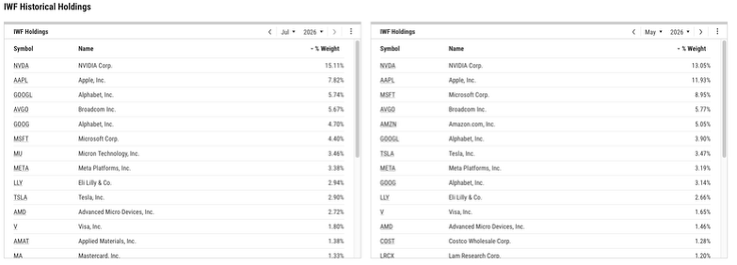
The annual reconstitution of the Russell 1000 growth index makes it, and by extension managers benchmarked to it, something of a momentum junky, and passive products tracking this index more active than they first appear. We would also point out that the Russell 1000 growth, as well as the Nasdaq 100, are also far less diversified than many investors might assume.
Aside from the concentration of the holdings, we would point out that the companies themselves have a similar set of opportunities and risks, most notably the AI Capex boom. Much of the large-cap stock market is increasingly looking like a bet on the success or failure of the economics of AI as a business.
The bond market was positive on the quarter, as current yield eclipsed a modest uptick in rates. Riskier bonds were higher, more so from the capital market environment becoming more benign. We have a new Fed chair, Kevin Warsh, and the market expectation is for some tightening this year, at some point, to try and keep a lid on inflation and inflation expectations. How much and when, or if it happens at all, is still an open question.
Early Third Quarter Developments
As we go deeper into summer, there appears to be some increasing skepticism in the market about the sheer amount of AI capex. The hyperscalers, which were formerly funding the buildout from operating cash flow, are now having to borrow or issue equity. While these companies are reporting strong earnings, free cash flow has deteriorated, and the quality of those earnings may be degrading.
These following charts from Bank of America are revealing.

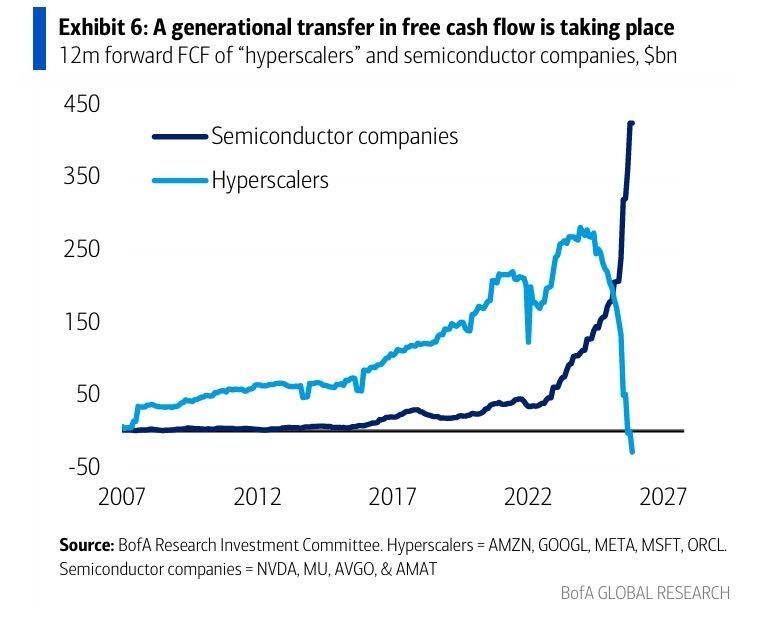
Meanwhile, less expensive Chinese open-source AI labs, reportedly spending far less on capex than their US competitors, seem to be only a few months behind the leading US frontier labs. It seems reasonable to question the durability of the moats, and the wisdom of the aggregate spend. How long US hyperscalers are content to ramp capex, which is something of a direct wealth transfer to semiconductor companies, with that competitive reality remains to be seen. The market seems to be having that debate in real-time this quarter.
Given the increasing risks and uncertainties, we think it is possible that diversification comes back into fashion.


