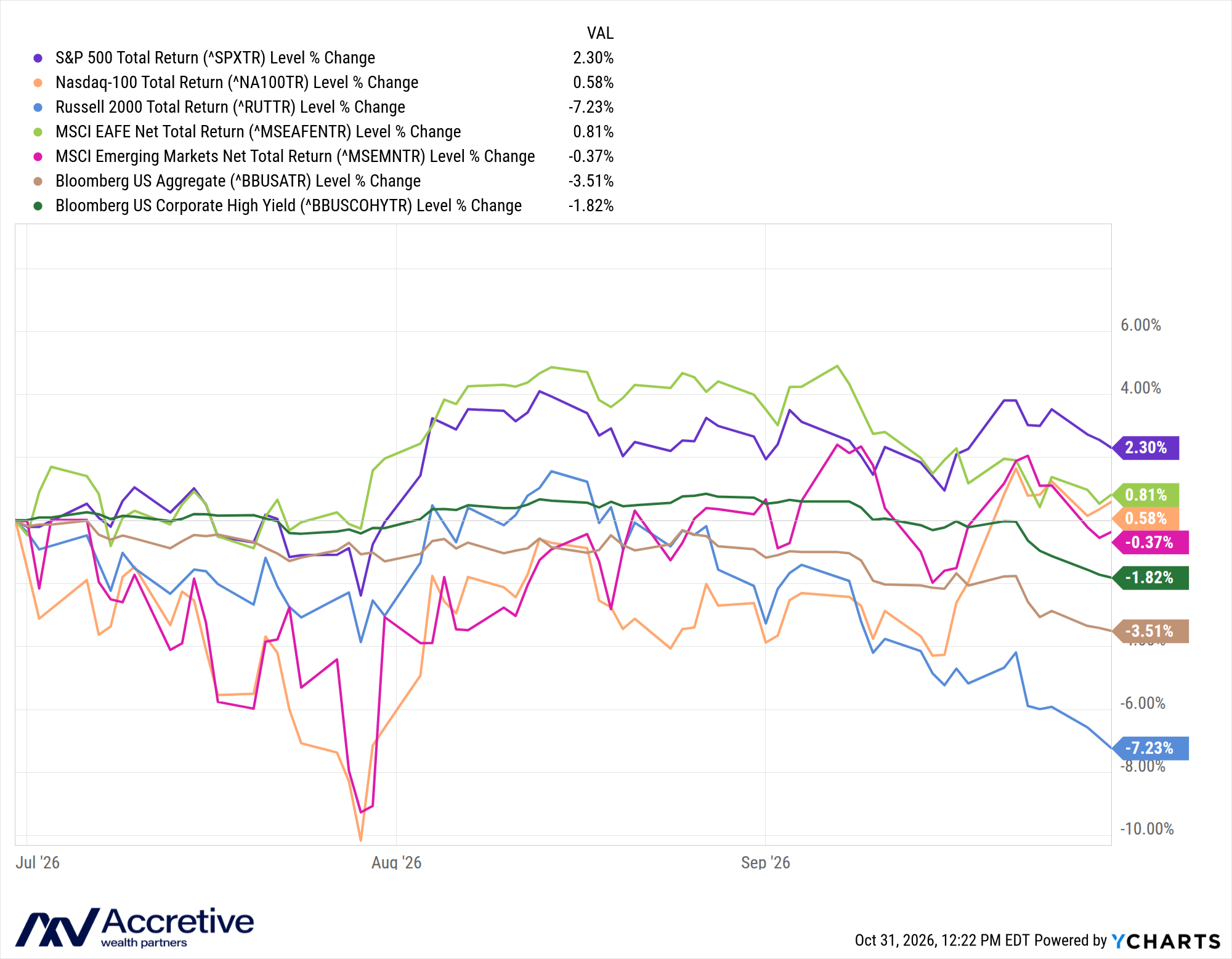
The third quarter was relatively uneventful for large cap stocks around the world. They were generally up modestly, except for emerging markets, which were down modestly. In the US, smaller companies fell over 7%, as it became clear the Fed was going to be tightening. Smaller companies are generally more adversely affected by and more sensitive to a rising rate environment.
The fixed income markets were the story of the quarter. The Fed began a tightening cycle in September, but bonds generally fell through most of the quarter. Interest rates rose all along the curve for US treasuries, the base rate that most of the bond market prices spreads against. Elsewhere in the fixed income markets, spreads also rose for borrowers. This makes sense to us, as spreads should be higher against higher base rates because servicing new debt is more costly and consumes more of an enterprise’s cash flow.
For a long time, the US treasury market had several relatively price-insensitive buyers: the Fed, the Chinese, and the Japanese. For different reasons, they are no longer large buyers of US debt. The Fed is no longer expanding its balance sheet, and Fed Chair Kevin Warsh is known to dislike quantitative easing and has commented that he believes the Fed’s balance sheet is too big. China had been recycling dollars from its trade surplus with the US into treasuries but have been diversifying away from treasuries for a long time. Japan also recycled its trade surplus into treasuries but now needs to prop up its currency. Taking relatively price-insensitive buyers out of the market exposes the US bond market to market forces and market prices.
What does the market see? The market sees high debt relative to US GDP, a large budget deficit with risks of increasing rather than decreasing, and demanding higher rates. The astonishing amount of borrowing by large US corporations to fund the AI build-out may also be crowding out the market for treasuries, adding further upward rate pressure. After a long hiatus, the bond vigilantes are back in force.
The open question to us is, when do higher yields in the bond market start to compete for investment dollars with stocks?
The AI Capital Cycle and Historical Comparables
It is hard to talk about investing these days without the topic of AI and the investment cycle coming up.
We think the most comparable capital cycle is the railroad boom of the mid-to-late 1800’s. The similarities are striking. A transformational new technology that altered society required massive amounts of capital to build. It featured rapidly increasing demand and promises of generational wealth creation for early investors. Outside investors were eager to fund the buildout, but returns on capital lagged the investment cycle considerably. When money got tight, the booms were followed by busts. For a long time, the benefits accrued more to society and industry insiders than to outside investors.
Similar to the railroads of the 1800’s, AI is an important and useful technology. It is hard to adequately describe investor excitement around its potential. While the technology has the potential to unlock meaningful productivity, it is unclear who ultimately reaps the returns on the investment. It may be that the ultimate returns accrue to society and industry insiders rather than investors, like the railroads. If money tightens, the cycle could slow considerably.
The two biggest AI frontier labs are investing heavily and making massive purchasing commitments. They have many agreements and commitments with the hyperscalers, neo-cloud providers, and chip manufacturers. To date, they’ve funded themselves by issuing equity to venture investors and their suppliers at higher and higher valuations. These companies are not yet profitable, so they will need to keep raising more money, which will invite public scrutiny of their financials. These labs represent the majority of cloud services backlog at the biggest public companies. A large amount of demand from paying customers comes from within the ecosystem itself, from venture-funded start-ups who are also unprofitable.
There is also the question of competition and whether or not these companies have a competitive moat. AI leadership seems to change every few months, and cheaper, open-source models seem to be only a few months behind. Paying customers seem to switch frequently and direct AI budgets to the lowest cost model that gets the job done. Currently, it does not seem to us that the lion’s share of the usage needs to happen at the frontier. As long as money is available, these companies can meet commitments and keep pushing the frontier. Still, if it isn’t available at ever-higher valuations, their ability to do so decreases. They, and their suppliers, are exposed to the risk that money suddenly gets tight and slows the buildout.
Until this year, the public companies doing the build-out have funded it primarily with cash flows from operations. Currently, those companies are spending so much that they have become cash-flow negative. They have resorted to tapping both the stock and bond market for capital. The interest rate spreads on their debt and the cost of insuring it against default have risen, while the estimates of their future capital expenditures have gone even higher. From our perspective, returns and cash flows from this investment need to start showing up soon, or money could get even tighter.
Early Fourth Quarter Developments
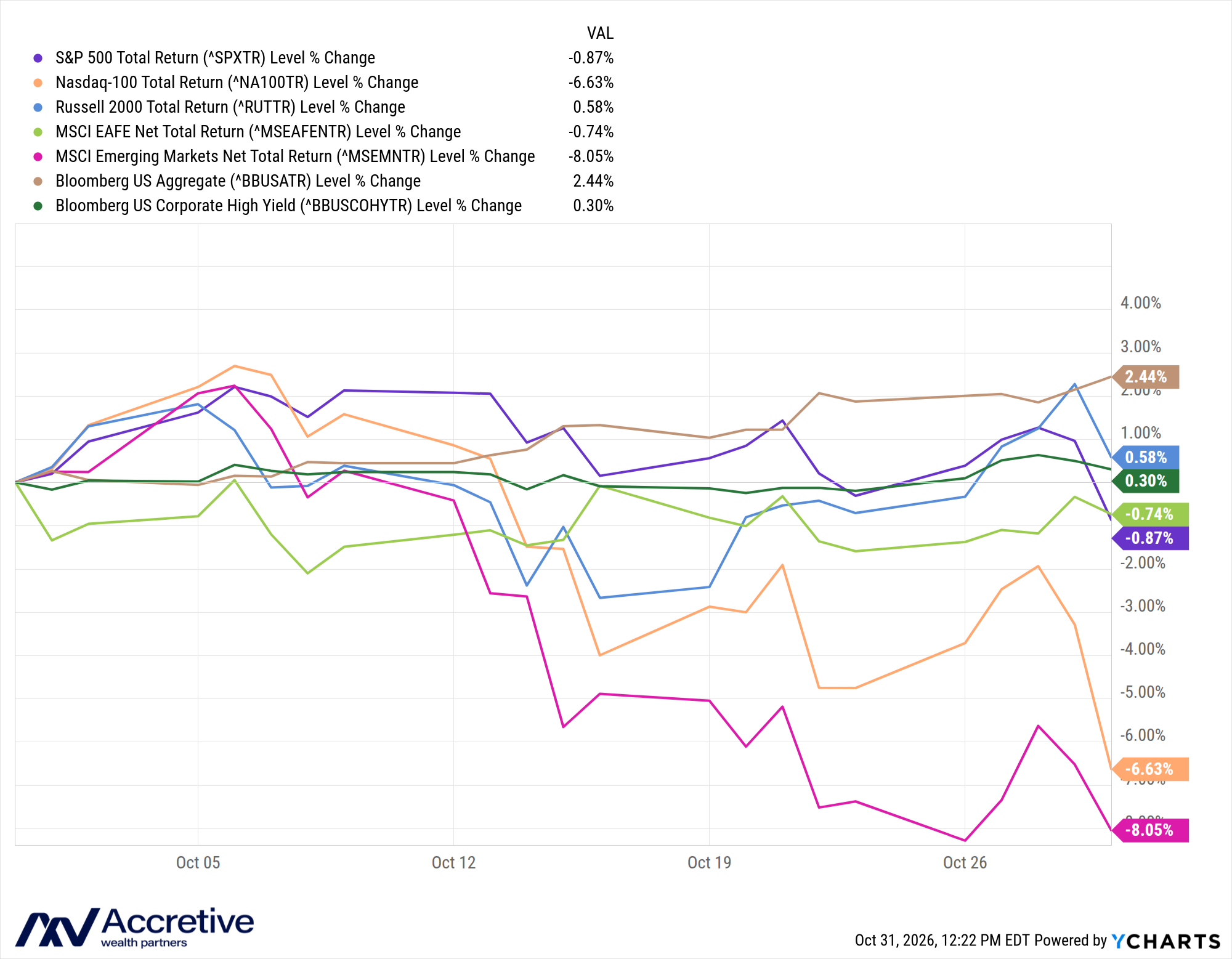
The month of October was a rough one for the Nasdaq in particular, as some of the concerns detailed above increased related to the AI capex cycle. Treasury yields have fallen a bit, but credit spreads have also widened, particularly among the lowest rated issuers.
Right now, the entire market is waiting on the timing and pricing of Anthropic’s upcoming IPO. Its public filings have disclosed over $800b of future commitments. How well the offering is received may heavily influence the future of the AI capex cycle.


